Google Wave Invite Competition

Google Wave Competition

Google Wave is a new way of communicating over the World Wide Web. It has been described as a merger between email and peer to peer technologies (for example merging your hotmail or Gmail account with with MSN or Gtalk)

Google have opened up this platfom up to initial number of BETA users. I have 5 FREE BETA Google Wave INVITES to GIVE AWAY NOW. This will give you full access to Google Wave immediately. To win one of these golden tickets all you have to do is subscribe to the social media strategist blog by clicking here. Once you have done so post a comment and I will send you an invite.

Information about Google Wave

A wave is equal parts conversation & document. People can communicate and work together with richly formatted text, photos, videos, maps, and more.

A wave is shared. Any participant can reply anywhere in the message, edit the content and add participants at any point in the process. Then playback lets anyone rewind the wave to see who said what and when.

A wave is live. With live transmission as you type, participants on a wave can have faster conversations, see edits and interact with extensions in real-time.

Win one of these golden tickets by subscribing to the social media strategist blog by clicking here.

Your Facebook Status Updates are no longer private!

Facebook, Myspace & Google have struck a deal which allows Facebook statuses, photos and other information to be cached (indexed) by Google. You may have already scanned over a set of terms and conditions over the last three days. If you have there is a good chance that you updated your privacy settings (possibly without knowing the consequences of these actions).

Why Should you Care?

If you have changed your Facebook security settings (to those prompted by Facebook) your status updates, address etc will all soon be found within Google. Therefore if someone searches for your name they could find out where you live, what you have been up to, what you have said / linked to in your status updates etc. If you decide to revert your settings back to private at a later date Google may (overtime) no longer display the content. However other organisations are able to crawl Google search engines with there own “search engine spiders”. They could at any stage capture your data, store it etc. The data itself could be used for credit card fraud, sold it on to third parties etc. If you have already agreed to the changing your security settings you can easily change them back. I will go through how to do so later in this post. If you have not already changed your settings please see the Facebook privacy guide below

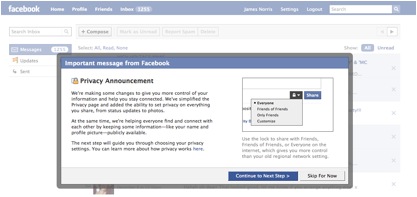
Login into your Facebook account. If you live in the UK and you do not see this popup box then you may have already made the changes without consciously being aware of it.
             Facebook privacy update guide

Click on the “Continue to Next Step” button. The next step is REALLY SNEAKY and (I feel) totally unethical. The screenshot below highlights how Facebook automatically prompts users to make changes to their privacy settings. It does so by automatically ticking fields ensuring that the content is viewable to “Everyone”.
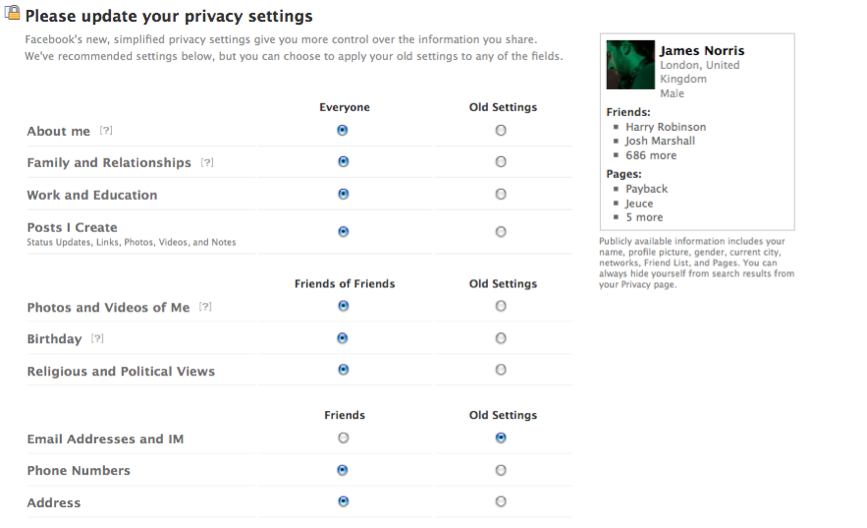
           Facebook Security Status

If a user clicked on the ‘save settings’ tab (as highlighted in the default screen above) the user’s posts, links and even their address would soon become publically accessible. If you do not understand the above I would recommend ticking all of the “old settings” boxes for each setting on this page. If you understand the above tick the appropriate fields before clicking on ‘Save Settings’.

How to change your Facebook privacy settings back

Facebook Security Status update

You will need to click on three out of the four pages to change your settings back. These are: Profile information, Contact information, Search

To view and change YOUR settings Click here & go straight through to your Facebook settings page

Again I feel that Facebook have acted unethically here. They have placed the position of the ‘Search’ link below that of the ‘Applications and Website’ link. The security settings found on the ‘search’ page are far more sensitive then that in the ‘Applications and Websites’ page. (The click though rate generally decreases the further down a user scrolls down a navigation tab).

In hindsight it is fine for Facebook to allow users to publish their details and statuses on the wider web. However Facebook’s covert and aggressive methods seem to bypass morality and common sense. Facebook is a fun platform and strongly interwoven into most our lives. We are therefore slow to question and judge this powerful corporation. The millions (maybe billions) of pounds this move will make Facebook has not yet been disclosed. However I hope that this incident brings to light our relationship with Facebook and further action is taken against them.

FYI – I have decided to set all of my privacy settings to how they originally stood. If Facebook statistics are to be believed 80-85% of Facebook users have allowed their information to be shared across the wider web. (Wired).

To subscribe to this blog and learn about how to use social networking sites effectively click here (and then click subscribe).

Send FREE Picture Messages To Radio 1

Radio 1 listeners will be able to send picture messages from their mobile phones to Radio 1 for free this Friday (11th December).

Listeners in the United Kingdom will be able to send free picture messages to the BBC Radio 1 messaging number (81199), for a chance to see their images featured on the Radio 1 website. UK participants on both pay as you go & monthly contracts will not be charged as part of the Radio 1s ‘free picture message day’.

It will be interesting to see how much over the air exposure Radio 1 DJs such as Pete Tong & Annie Mac give to this project. The Mobile Data Association (MDA), brought together each of the UK’s major mobile network operators to form a partnership with the BBC which aims to get more young people involved with the station. The MDA has also launched an educational website with the long-term aim of helping people to send picture messages: http://www.getsettings.org .

Ben Chapman, Interactive Editor at BBC Radio 1, said: “Our goal is to mix the listeners’ picture messages with images of our DJs in an innovative way, so they all follow the theme of a well known piece of music. It’s a brilliant opportunity for Radio 1 to produce interactive content while explaining how to get the most out of mobile phones, and it encourages more interaction with our DJs.”

                    Radio 1 Free Mobile Messages     Radio 1 mobile phone marketing

Martin Ballard, Operations Director at the MDA, said: “BBC Radio 1’s Picture Messaging Day should provide a springboard to generate further interest in the medium. Our getsettings website aims to address configuration issues around older handsets in circulation and SIM-only contracts. But the emergence of increasingly sophisticated and affordable devices means users can begin to capitalise on the rich mobile messaging facilities which are now available, as they did with text messaging at the beginning of the decade”.

Sources:
The Mobile Data Association newsletter, Radio 1, GetSettings

Pot Noodle’s & Space Invaders

Chicken Pot Noodles have remained a staple part of my diet for the last 20 years or so.

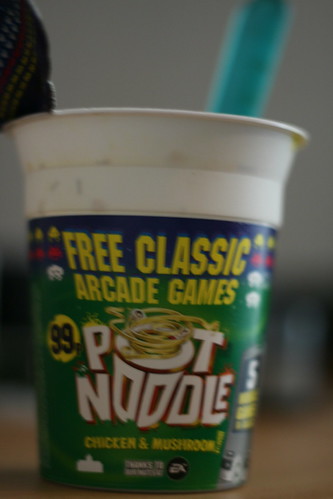
Whilst scanning the pasta in my local (and well over priced) mini-mart the Daddy of Pasta once again grabbed the eye. The retro game Space Invaders appeared all over the Chicken & mushroom Pot Noodle packaging….  Space Invaders on the Pot Noodle packaging = SOLD.

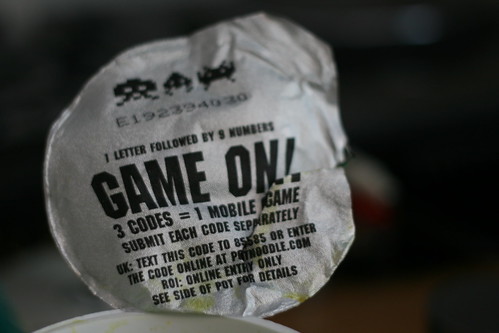
On a closer inspection it turns out that the Pot Noodle promotion is based around sending classic computer games to Pot Noodlers mobile phones (for free). Most food and drink package promotions are awful and not worth a second glance. However in this case “3 Codes = 1 Mobile Game”(Pot Noodle Packaging).

For More info about the Noodle & the games you can download go to The Pot Noodle website

              pot noodle lid       Pot Noodle Game

Free Online Alarm Clock Tutorial / Review

There are a number of free online alarm clocks available on the world wide web.  With the recent failure of my Nokia N95 and the slow decay of my spare phone I have been left without a reliable alarm clock.

Last week I decided to turn to an online alarm clock


I used the first alarm clock that I stumbled upon http://onlineclock.net (and it didn’t let me down). I did however foresee that my Mac’s energy saving mode might stop the alarm from going off. I have tested this theory since and was right to make this assumption.

If you do decide to use this online alarm clock then you should:

  1. * Disable the energy saving mode/ screen saver
  2. * If you are using the online clock via a laptop ensure that it is plugged in
  3. * Take out any headphones that are plugged into your laptop / desktop
  4. * If you are using external speakers switch them on.
  5. * Switch up the volume on your laptop / desktop.
  6. * Test the alarm (set it to go off in a minute later).
  7. * Set the alarm
  8. * Have good night’s sleep

This is a simple yet effective alarm clock. I would recommend using this tool as and when your mobile phone fails. There are a number of more advanced features such as changing the alarm sound to live streams from internet radio stations however I decided to use the default alarm.

Online advertising spend Vs TV spend (UK data)

Online advertising spend now boasts 23% of the advertising market share in the UK. (data taken from the first half of 2009, IAB) It is now the largest advertising medium in the UK. (IAB)

In these troubled times marketers need to justify their advertising budgets. When an online marketing campaign is executed and delivered correctly the return on investment can be huge. Furthermore the ability to quantify success, views, engagement etc makes it a much more attractive proposition to many brands & organisations over  print, TV advertising etc. Many experts predicted a huge disruption within the TV advertising sector in 2010. However these premature findings further justify that not only is the digital industry is stable and robust but also that it is a trusted medium for brands & organisations alike

RFID Breakfast

On Tuesday I attended KTN & GS1’s ‘Wake up to RFID – breakfast with chips’. This was an informative breakfast where we discussed all things RFID (Radio frequency identification). RFID is the technology used in mobile phones also known as ‘NFC’. RFID chips are currently used in passports, Oyster  cards and banks cards. RFID readers have already been implemented into a small number of mobile handsets. In the coming years NFC is set to become a massive part of our day to day lives and transform the way we use our mobile phone. When a NFC enabled phone comes into a close proximity of a RFID chip it triggers an action. This may be for content (such as a marketing video) to be sent to your phone.  Alternatively the action could be set so your phone pays for an item that you have purchased.

I attended this event to help better my understanding of NFC and learn of how it is currently being used in healthcare.  The event was a small yet focused group. Many of those who attended are currently pioneering the development and adoption of NFC.  It was an interesting discussion and I found it useful in terms of how we can and will be able to use this medium going forward.

I was however shocked to learn that the greatest advocate and one of the largest investors in NFC is the US military. The US are also rumoured to be able to activate ‘passive’ RFID chips from up to 30ft away. This rumour becomes even more shocking when placed next to the millions of pounds currently being spent by governments on integrating RFID chips into passports & national ID cards.

Data on Marketers using Social Media

A new study from the Association of National Advertisers* highlights that 66% of marketers have now used social media in some way in 2009. This is a massive growth since 1997 when the same survey found that only 20% of marketers used social media 

The top platforms being used by marketers were found to be: 

  • Facebook 74%
  • Youtube 65% 
  • Twitter 63% 
  • Linkedin 60% 

Social media (including blogs) is the fastest growing marketing segment. It is estimated social media will be a $3.1 Billion industry by 2014 * The Association of National Advertisers leads the marketing community by providing its members with insights, collaboration, and advocacy. ANA’s membership includes 400 companies with 9,000 brands that collectively spend over $250 billion in marketing communications and advertising. The ANA strives to communicate marketing best practices, lead industry initiatives, influence industry practices, manage industry affairs, and advance, promote, and protect all advertisers and marketers (blurb via Association of National Advertisers).

Why should businesses use social media?

Social Media has transformed the way that we commincate with one another. Furthermore this has been the most disruptive element in marketing since the arival of the television. Social media allows brands and organisations to reach their targeted audience and engage with them in a way that relates to them as individuals. When the key goals and objectives have been defined a social media strategist will evaluate these goals & objectives and create a strategy on how best to reach them. Below is a recent video by an American Chap that highlights how social media fits into the world today 

Using a Charity Twitter Account

This guide helps charities increase their outreach / make money from Twitter. Once you have setup a Charity Twitter account it is time to start ‘tweeting’.

1>Answer questions that others have asked. Twitter is a tool to communicate with your audience. Engauge with your followers no matter how big the charity is.

2>Make your tweets interesting

3>Use hyperlinks in your tweets and direct traffic back to a relevant page on your website. (please see previous post)

4>Use twitter to headhunt new job applicants. This could save thousands on recruitment consultant fees.

5>Use a #hashtag’s for all of your charity posts. This will help you gauge the reach of your tweets over time. An example of which may be #DiabetesUK

6>Ask for donations / micro donations

7>Promote your twitter account on your website, blog etc…